

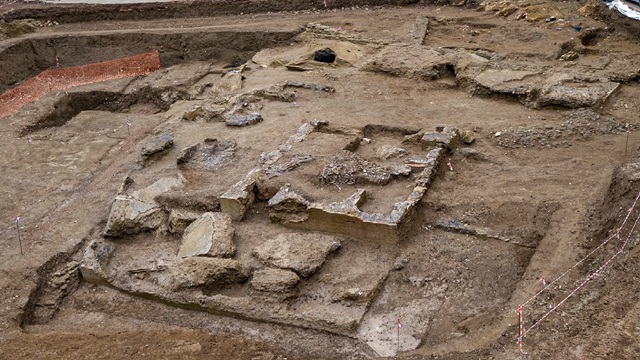
Nel corso delle indagini di archeologia preventiva condotte dal Ministero della Cultura – Soprintendenza Speciale di Roma, per la realizzazione di uno studentato sulla via Ostiense, in zona San Paolo Fuori le Mura, è stata scoperta una vasta area funeraria, con tombe in muratura decorate e sepolture a fossa, eccezionalmente ben conservata.
“La Necropoli Ostiense, una delle più estese dell’antica Roma, ci regala un’altra importante testimonianza che, grazie alla Soprintendenza Speciale di Roma del Ministero della Cultura, verrà tutelata, studiata, valorizzata senza impedire il progetto di un nuovo studentato e anzi con l’auspicio di rendere i ritrovamenti visitabili”, ha commentato il ministro della Cultura, Alessandro Giuli. “Una volta di più le Soprintendenze si dimostrano il punto di incontro tra le esigenze del territorio e la cittadinanza per conservare e consegnare alle generazioni future i valori del patrimonio culturale italiano”, ha aggiunto.
Per la soprintendente speciale di Roma, Daniela Porro, “questo rinvenimento conferma la straordinaria complessità del patrimonio archeologico della città, che continua a emergere anche nei contesti interessati da trasformazioni urbane. La qualità delle strutture, l’organizzazione degli spazi e la ricchezza degli apparati decorativi rappresentano un’importante occasione di approfondimento scientifico. La Soprintendenza”, ha assicurato Porro, “garantirà la piena tutela del complesso e avvierà un significativo progetto di valorizzazione, per restituire alla cittadinanza i risultati della ricerca”.
Dallo scavo, diretto da Diletta Menghinello, archeologa della Soprintendenza Speciale di Roma, è emerso, a circa un metro di profondità, un nucleo di cinque edifici funerari d’età imperiale a pianta quadrangolare con copertura a volta, allineati da nord-est a sud-ovest e preceduti da due strutture minori. Un sesto edificio, analogo agli altri ma a essi perpendicolare, suggerisce, insieme ai resti di ulteriori ambienti, l’organizzazione del complesso attorno a un cortile interno.
“Lo scavo dei sepolcri, molto probabilmente identificabili come colombari, ambienti dotati di nicchie destinate a ospitare le urne cinerarie, è ancora in una fase preliminare”, ha spiegato Menghinello. “Nella limitata porzione attualmente visibile delle camere sepolcrali, è comunque già possibile riconoscere un elaborato apparato decorativo, costituito da intonaci affrescati a fasce e a motivi vegetali, stucchi, edicole ornate da figure della simbologia funeraria romana, come Oranti o Vittorie Alate. La prosecuzione dello scavo potrebbe consentire il rinvenimento di numerosi elementi di corredo, epigrafi e rivestimenti pavimentali”.
Nell’area più prossima alla strada, a profondità via via maggiori, sono stati inoltre rimessi in luce un’aula absidata e un altro grande ambiente con resti di pavimentazione a mosaico, entrambi in laterizi, la cui funzione si chiarirà con il procedere dell’indagine. In età tardo-antica, una necropoli assai più modesta si impianta alle spalle del settore monumentale occupato dalle tombe di età imperiale, dal quale è separata da un lungo muro in blocchetti di tufo: scarsi oggetti di corredo accompagnano semplici sepolture a fossa, sovrapposte le une alle altre in fitta successione.
Il contesto, particolarmente ricco e stratificato, va ricondotto alla vasta Necropoli della via Ostiense, sviluppatasi tra la tarda età repubblicana e il tardo impero, di cui sono attualmente visibili i settori del Sepolcreto Ostiense e della Rupe di San Paolo.
“Queste scoperte archeologiche”, ha osservato Luigi La Rocca, capo Dipartimento per la Tutela dei Beni Culturali, “evidenziano come uno strumento normativo, ovvero la verifica preventiva dell’interesse archeologico, costituisca una opportunità di ricerca e di conoscenza della storia di Roma, che non finisce di stupire per la sua stratificazione, e fornisca, al tempo stesso, l’occasione per riflettere sul tema della conservazione del patrimonio ritrovato e della sua possibile integrazione nel tessuto e nei bisogni della città moderna, in un comparto urbano interessato da profonde trasformazioni”.
Le nuove scoperte, articolate in una lunga fase temporale tra la prima età imperiale e la tarda antichità, costituiscono un rinvenimento di grandissima rilevanza, in grado di fornire informazioni nuove e preziose sull’impianto topografico, nonché sugli aspetti antropologici, epigrafici e di cultura materiale della Necropoli Ostiense. (aise)
During the preventive archaeology investigations conducted by the Italian Ministry of Culture – Special Superintendence of Rome, for the construction of a student residence on the Via Ostiense, in the San Paolo Fuori le Mura area, a large funerary area was discovered, with decorated masonry tombs and pit burials, exceptionally well preserved.” The Ostiense Necropolis, one of the largest in ancient Rome, gives us another important testimony which, thanks to the Special Superintendence of Rome of the Ministry of Culture, will be protected, studied, and enhanced without impeding the project of a new student residence and indeed with the hope of making the finds visitable,” commented the Minister of Culture, Alessandro Giuli. “Once again, the Superintendencies prove to be the meeting point between the needs of the territory and citizenship to preserve and deliver to future generations the values of the Italian cultural heritage,” he added. For the special superintendent of Rome, Daniela Porro, “this discovery confirms the extraordinary complexity of the city’s archaeological heritage, which continues to emerge even in contexts affected by urban transformations. The quality of the structures, the organization of the spaces, and the richness of the decorative apparatus present an important opportunity for in-depth scientific study. The Superintendency,” Porro assured, “will guarantee the full protection of the complex and will launch a significant enhancement project, to return the results of the research to the citizenry.” From the excavation, directed by Diletta Menghinello, an archaeologist of the Special Superintendence of Rome, a nucleus of five funerary buildings of the imperial age with a quadrangular plan and a vaulted roof, aligned from north-east to south-west and preceded by two minor structures, emerged at a depth of about one meter. A sixth building, similar to the others but perpendicular to them, suggests, together with the remains of other rooms, the organization of the complex around an internal courtyard.” The excavation of the tombs, most likely identifiable as columbaria, rooms with niches intended to house the cinerary urns, is still in a preliminary phase,” explained Menghinello. “In the limited portion currently visible of the burial chambers, it is already possible to recognize an elaborate decorative apparatus, consisting of frescoed plaster with bands and plant motifs, stuccoes, aedicules adorned with figures of Roman funerary symbolism, such as Oranti or Winged Victories. The continuation of the excavation could allow the discovery of numerous grave goods, epigraphs and floor coverings”. In the area closest to the road, at progressively greater depths, an apsidal hall and another large room with remains of mosaic flooring, both in brick, were also brought to light; the function of these will be clarified as the investigation progresses. In late antiquity, a much more modest necropolis was established behind the monumental sector occupied by the tombs of the imperial age, from which it was separated by a long wall of tuff blocks: scarce grave goods accompanied simple pit burials, superimposed on one another in dense succession. The context, particularly rich and stratified, can be traced back to the vast Necropolis of the Via Ostiense, developed between the late Republican age and the late empire, of which the sectors of the Ostiense Burial Ground and the Rupe di San Paolo are currently visible.” These archaeological discoveries,” observed Luigi La Rocca, head of the Department for the Protection of Cultural Heritage, “highlight how a regulatory tool, i.e. the preventive verification of archaeological interest, constitutes an opportunity for research and knowledge of the history of Rome, which never ceases to amaze for its stratification, and provides, at the same time, an opportunity to reflect on the theme of the conservation of the rediscovered heritage and its possible integration into the fabric and needs of the modern city, in an urban sector affected by profound transformations”. The new discoveries, articulated over a long time phase between the early imperial age and late antiquity, constitute a discovery of great importance, able to provide new and valuable information on the topographical layout, as well as on the anthropological, epigraphic, and material culture aspects of the Ostiense Necropolis. (aise)