

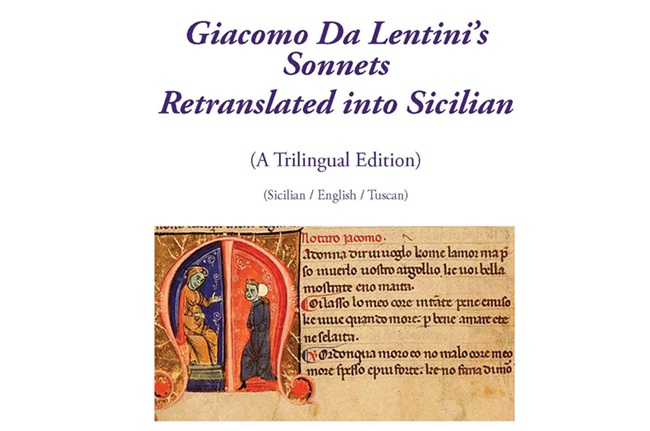
Nearly eight centuries separated the Sicilian poet Giacomo da Lentini and Professor Gaetano Cipolla. Giacomo worked as a notary at the court of Emperor Frederick II in the first half of the thirteenth century. Gaetano, born in Sicily in 1937, devoted decades of his scholarly life in America to sharing the island’s language and literature with the world. In 2026, now in his late eighties, he published a book that helped modern readers hear Giacomo’s poetry in Sicilian again. Across that enormous distance of time, Gaetano had reached toward the poet with a scholar’s knowledge and the love of a fellow Sicilian.
The imperial court brought together educated officials who found time for poetry alongside the business of government. Giacomo came from Lentini, in eastern Sicily, and his profession gave him the name by which he entered literary history: Il Notaro. As an attorney and a writer, I confess to a certain pleasure in that detail. A man who worked with formal documents also understood the disorder of the human heart well enough to help change the way the world wrote about it.
He is generally credited with inventing the sonnet, that small, demanding arrangement of fourteen lines in which an emotion or an argument must find its proper shape. Petrarch later explored its possibilities, and centuries afterward Shakespeare wrote some of the most beloved sonnets in English. Before those names acquired their enormous reputations, a Sicilian notary and his fellow poets were helping establish a literary tradition at Frederick’s court. They drew on the troubadours of Provence and fashioned a polished literary Sicilian capable of expressing the finest distinctions of longing and devotion.
Their world can seem very far away until we listen to what Giacomo said. In one sonnet, he resolved to serve God so that he might reach Paradise, then admitted that he would be reluctant to go without his beloved. He hastened to explain that his intentions were honorable; seeing her there in glory would be his consolation. I find that confession irresistible. Beyond the robes and ceremonies of a medieval court, here was a man contemplating eternal happiness and wondering how it could possibly be happiness if she were somewhere else.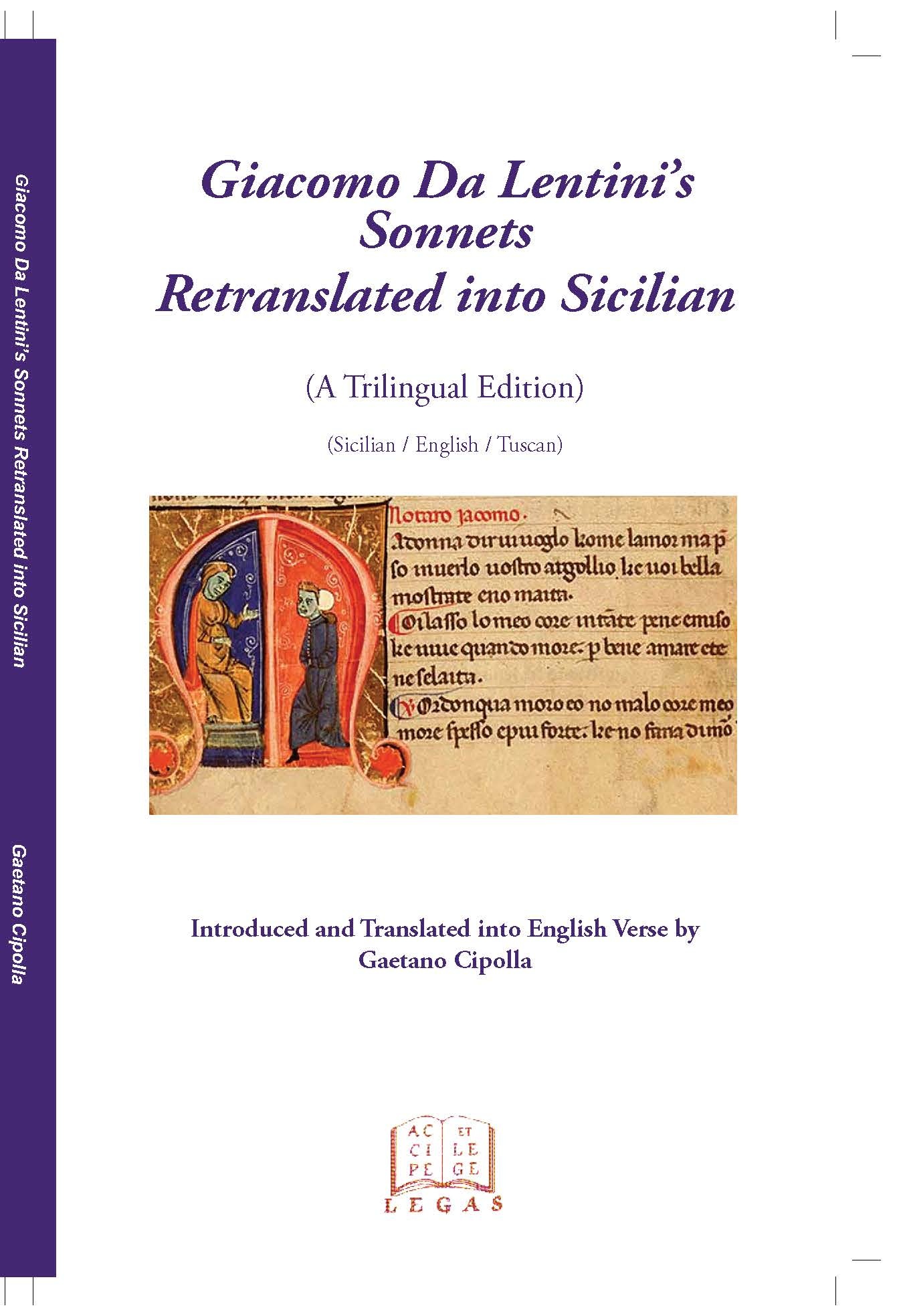
The words in which he expressed that tenderness belonged to Sicilian, a language that had developed from Latin along a different path from Tuscan. The poets refined it for the needs of their art, drawing on the literary vocabulary of their time. They made it carry difficult ideas as well as affection. For those of us accustomed to hearing Sicilian in a remembered family expression, there is something deeply stirring in discovering the place it held in that early chapter of Italian literature. The language of someone’s grandmother was also a language in which poets had enlarged the possibilities of the written word.
Then the political order that supported them fell apart. Frederick died in 1250, and the defeat of his son Manfred at Benevento in 1266 further shattered the dynasty’s power. Most of the School’s poetry failed to survive in its original Sicilian form. Much of what reached later readers came through manuscript copies made elsewhere, especially in Tuscany. We owe those scribes a considerable debt, because they preserved works that might otherwise have vanished. Yet, as they copied, they commonly adapted the poems to their own linguistic habits. The words survived a journey during which their sound and shape had changed.
That loss deserves to be felt as well as explained. Imagine a song you have loved since childhood, heard in a familiar voice, and then imagine encountering it after its sounds have been rearranged. You might still understand its message while feeling that something intimate had escaped. Poetry lives in such intimacies. The length of a word, the place where the voice rests, the answering sound at the end of a line all help carry the feeling. The Tuscan adaptations preserved much of the poets’ meaning, but they also obscured features through which the Sicilian verse had achieved its music.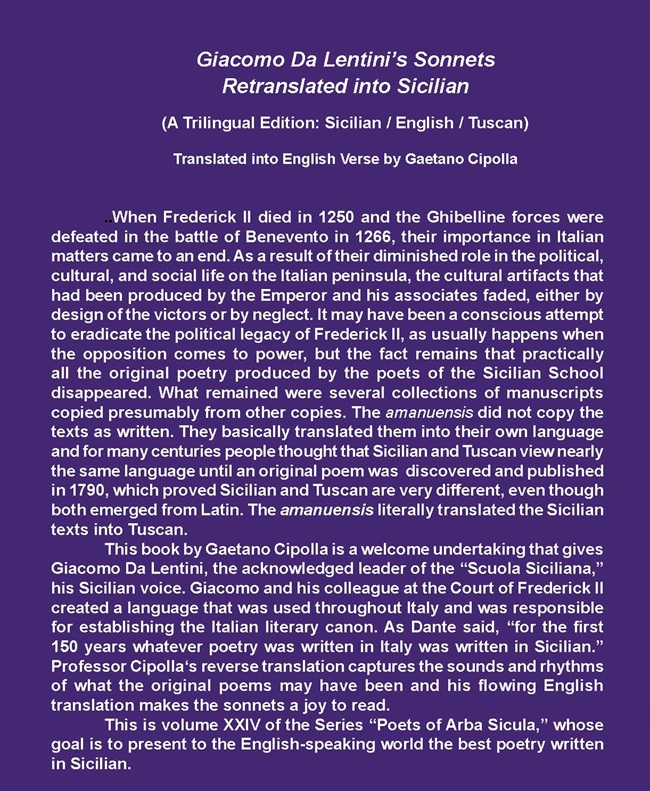
Cipolla illustrated the problem with the sonnet about Paradise. In its transmitted form, the rhyme words included servire, dire, gire, and gaudere, with the last word breaking the expected match. The corresponding Sicilian forms, sirviri, diri, jiri, and gaudiri, allowed the rhyme to fall into place again. What had seemed an irregularity became understandable when heard in Sicilian. Such altered rhymes entered literary history as Sicilian rhymes, even inspiring later poets to imitate them. The sound of the copying had become confused with the sound of the poet.
The familiar manuscripts also encouraged mistaken ideas about how closely medieval Sicilian resembled Tuscan. Important contrary evidence reached print in 1790, when Girolamo Tiraboschi published material preserved by the sixteenth-century scholar Giovanni Maria Barbieri. It included a poem by Stefano Protonotaro transmitted in a recognizably Sicilian form. Readers had evidence of a difference that generations of adaptation had obscured. Across the centuries, one could begin to hear more clearly how much of the island’s own voice had been left behind.
More than a century and a half after that publication, in 1955, an eighteen-year-old Gaetano Cipolla left Sicily for America. Born in Francavilla di Sicilia in 1937, he carried memories of an island childhood that remained vivid when he described them many years later. His education and professional life took him into American universities, including St. John’s University in New York, where he taught Italian language and literature for more than three decades. He became Professor Emeritus of Italian. Along the way, Sicily grew into an enduring commitment, expressed through the scholarship to which he devoted so much of his working life.
There is a lovely moment in his own account of how that commitment developed. Asked to recite poetry in Sicilian at New York University, he read Giovanni Meli. In explaining its effect, he spoke of the shiver that true poetry could produce, especially in the language learned as a child. The experience helped awaken an interest that grew into years of work. I find it moving that a lifetime of research and publishing could be nourished by something as immediate as the feeling produced by a familiar sound. A scholar’s learning gave him the means to follow where that feeling led.
He wrote Learn Sicilian / Mparamu lu sicilianu, an interactive grammar, and The Sounds of Sicilian, a guide to pronunciation. He also edited J. Kirk Bonner’s Introduction to Sicilian Grammar. These books helped readers approach Sicilian with understanding and confidence, including people whose families had lost the language between one generation and the next. There is affection in such practical work. To teach someone how a language works is to give that person the possibility of entering it, hearing its distinctions, and discovering what once seemed beyond reach.
Through translations and publishing, he introduced readers to Giovanni Meli, Nino Martoglio, Antonio Veneziano, and other Sicilian poets. He became president and editor of Arba Sicula in 1987, giving decades of effort to making the island’s culture known beyond its shores. The accumulated books and journals record an immense amount of labor. I also see in them his conviction that Sicilians deserved to be understood through the imagination and humanity of their writers. My friend and mentor had spent years placing those voices within reach of people who might otherwise never have encountered them.
All that experience accompanied him when he undertook Giacomo da Lentini’s Sonnets Retranslated into Sicilian, published by Legas in 2026. The medieval poet had written in a world of handwritten manuscripts; the modern scholar addressed readers scattered across countries and generations. Working backward from the transmitted texts, Gaetano produced Sicilian versions through which those readers could hear something of the music the Tuscan adaptations had obscured. He also provided English translations and included the transmitted texts, allowing the poems to reach people with different levels of familiarity with Sicilian.
The labor was in the choices. A word might convey the meaning and still disturb the rhythm; a familiar expression might sit awkwardly beside a medieval idea. He had to weigh the sound against the thought and consider what the line could bear. Today’s Sicilian had itself changed over the centuries, and some vocabulary belonged to a vanished literary world. The book drew on the knowledge he had gathered through years of teaching and translation, putting that experience at the service of individual lines whose readers might never realize how much consideration they had required.
He acknowledged the limits with scholarly honesty. Earlier scholars had attempted similar work, and he discussed their efforts respectfully. His own versions were informed retranslations; the precise wording of the lost originals could not be established with certainty. What he offered was a way for a modern reader to encounter Giacomo in Sicilian again, with renewed attention to the language’s sound and rhythm. His affection for the poet lived alongside that care. The tenderness of the undertaking becomes more moving when we recognize how conscientiously he approached what time had made uncertain.
In his preface, Gaetano described how hearing his Sicilian version of one of Giacomo’s poems had touched him in a way the Tuscan version had not. He wrote that the language learned in childhood reaches deep into memory, awakening connections that time has allowed to sleep. Across all those intervening centuries, the old words had stirred something living in him. It was a response recognizably related to the feeling he had described when reciting Meli years before. The scholarship had carried him a very long way, and the language could still move his heart.
His age gives this completed book an added poignancy for me. By 2026 he is in his late eighties, with a substantial record of teaching and publishing already behind him. He gave further effort to a poet whose world had disappeared nearly eight hundred years earlier, and offered the result to people who were still discovering their Sicilian inheritance. As an older writer myself, I find something heroic in that generosity. There is faith in the act of making another book, faith that somebody will open it and find something worth carrying forward.
For more than twenty-five years, he has been my friend and mentor. He was my editor at Legas for my first four books, and that makes my affection for him inseparable from my own life as a writer. When I look at this new volume, I think of the care he gave to my words and the encouragement he gave to me. I know how much it can mean to have someone believe that a voice deserves to be heard. Giacomo can no longer thank him, but I can, and I do.
I think of the young notary shaping a poem for his beloved, and of the older scholar who brought a lifetime of learning to those surviving words. Between them lay the loss of manuscripts, the changes of language, and the long passage of generations. Gaetano gave us a way to listen across that distance. Giacomo wrote about love, and nearly eight centuries later, another Sicilian loved those words enough to bring their music home.
Alfred M. Zappala
Attorney
www.alfredzappala.com